This post is part of a series entitled A Year With My Camera.
Lesson 2.4 in my own words
- Think about what you're trying to say with your photographs. How do you want them to speak to the viewer?
- Composition is the language of photography. It's the backbone of a photograph.
- Think about:
- Where do you put everything in the frame?
- What do you leave out?
- How do the elements relate to one another?
- How can you use these principles to translate the scene you see into the finished image you see in your head?
- With practice, composition will come naturally.
This week's project
- Answer this question - "Why do you take photographs?"
- Try some of these advanced composition techniques:
- Visual weight
- What elements draw the viewer's attention?
- Do they compete with or distract from your chosen focal point?
- What's leaving the frame? Don't let cut-off objects on edges distract from the subject.
- What's overlapping? Give each element it's own space.
Why do I take photographs? I've been thinking about this and have pinpointed two reasons: documentation and communication. I don't see myself as an artist, so my photography isn't driven by a desire to create. Neither an I trying to elicit an emotional response from the viewer. Rather, my motive is to record the when, how, and why of our lifestyle, including its sorrows and joys. Even so, I want my photos to be interesting to look at and aesthetically pleasing. And I do enjoy the creative challenge to make them that way. So, I suppose I can add "personal satisfaction" to the reasons why I take photographs.
Practicing the composition techniques.
 |
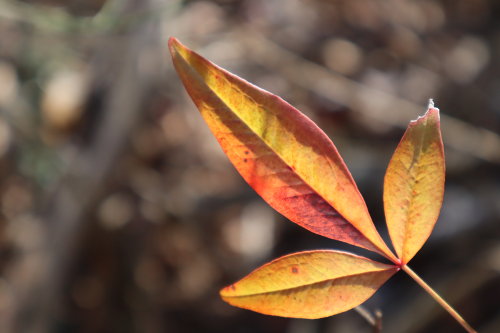
| Visual weight: the eye is repeatedly drawn to the subject. I like that there is good contrast with the background, and that the branches create diagonal leading lines, all leaning toward the subject. |
 |
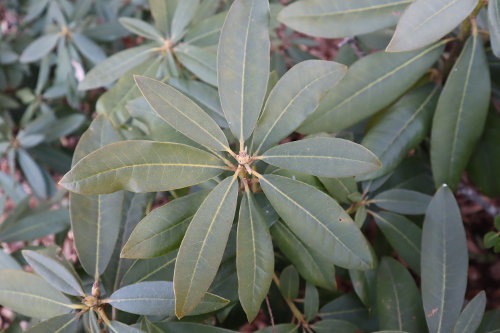
| What's leaving the frame? I understand this concept, but my usual method of photography is simply to take a bunch of pictures and then crop them in Gimp. |
 |
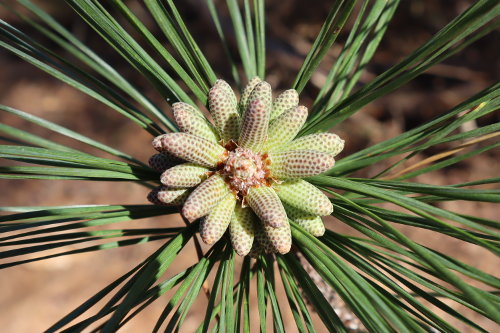
| Now, I'm trying to be more deliberate in analyzing the composition of my shots beforehand. For this one, I changed my point-of-view. |
 |
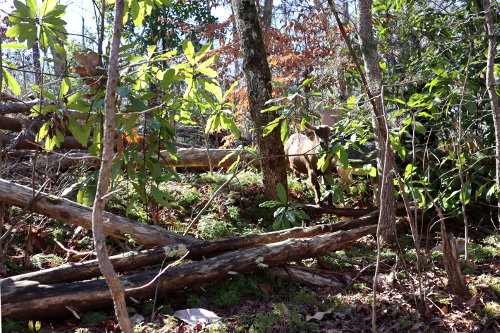
| Overlapping. Taking photos of animals is tough because they don't pose and they don't stay put. |
 |
| Even though their bodies are overlapping, I think this photo works because each of their heads has a defined space. |
And that concludes part two of A Year With My Camera.